You know how sometimes you hear or read something that just sticks with you and rattles around in your brain? Something that was initially just a random find, but it keeps coming back to you?
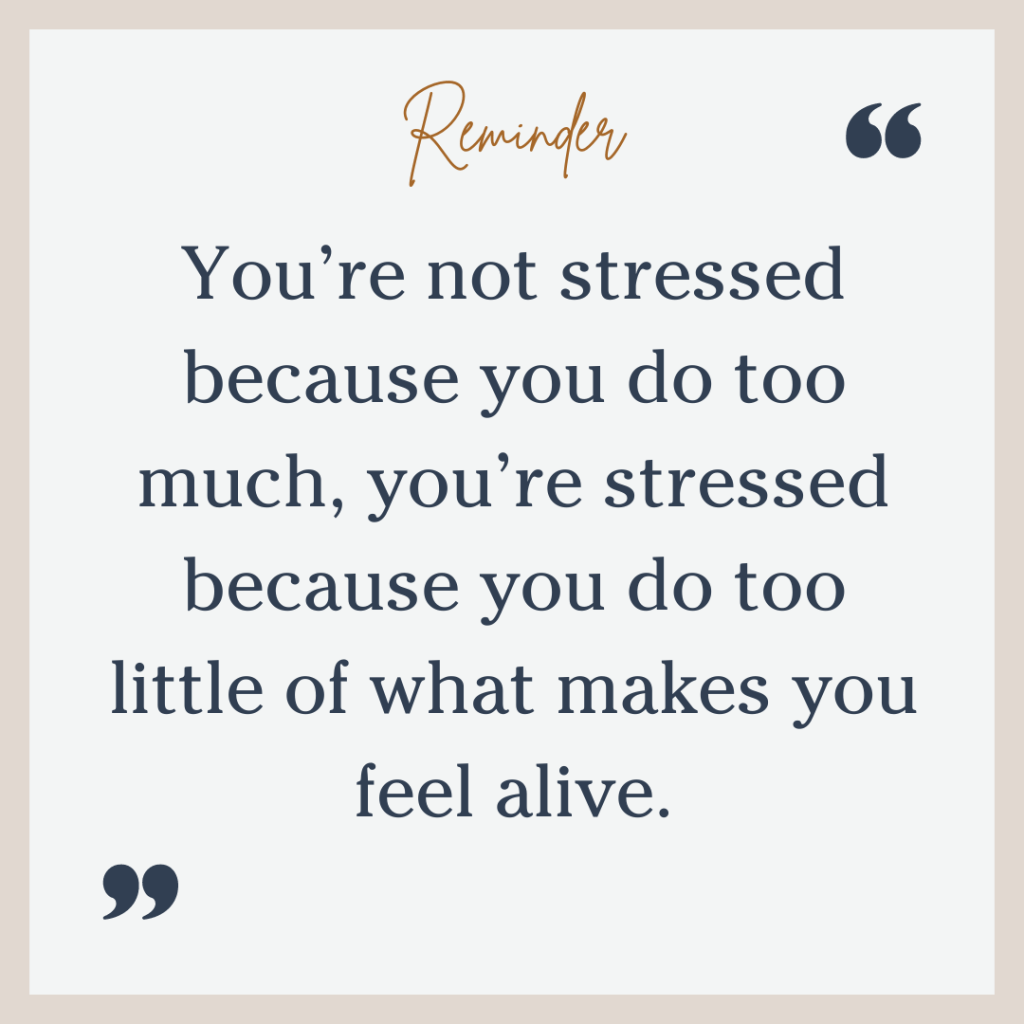
About a month ago I saw a post somewhere that said “You’re not stressed because you do too much, you’re stressed because you do too little of what makes you feel alive.”
The idea really struck me because as an educator, a parent, and just a person, I often am trying to manage stress and anxiety. I’m often trying to find ways to lower my stress and recognize when I’m feeling less stress.
Some answers to dealing with stress seem obvious like trying to avoid stressful situations when you can. But what I really liked about this quote was that it wasn’t about avoiding the things that might give you stress, but about focusing on the things you enjoy and that make you feel alive.
Ever since I read it, I’ve had a new lens to examine how I am choose to spend my time both in and outside of work.
At work there are, of course, things that I will need to do whether I want to or not. Thankfully I really do like most of the things I need to do.
In my current role I have some flexibility with my time, and it could be easy to let certain more mundane tasks (email, vetting, ClassLink tickets, etc.) overwhelm my days.
But with this new (or maybe just renewed) outlook, I have been making a conscious effort to spend more time doing the parts of my job that bring me joy while still accomplishing my goals. I’ve found that spending more time connecting directly with people is at the top of that list.
I coach instructional coaches throughout the district and have been prioritizing going to their schools and talking with them more often. While this brings me more joy, I also think it’s positively impacting them and the work they do.
I’ve been talking to administrators in the schools I support and finding out what’s on their minds and what their priorities are. This too brings more joy to my work.
And I continue to look for ways to get into schools and classrooms so I can connect directly with students and teachers. If you want to feel alive, a classroom is a great place to be!
I’m thankful for work that allows me to find joy and to help others. I recognize that the flexibility and opportunities I have are not something that everyone gets, so I try to appreciate them as much as possible.
I’m also thankful for having options to find joy in my time away from work. I love spending time with friends, seeing my family when I can, being outside in nature, reading, walking, learning and so much more.
I hope that everyone is able to find at least one thing to do this week that makes you feel more alive!
Last week we officially launched our district’s new instructional coaching team with a back to school professional development day. It was an incredible day of collaboration and learning. With intentional planning, we were able to help launch a new approach to teacher support in our district. Although we’ve just started with this team, we’ve been headed this way for years.
For over 10 years our district has had Digital Integration Specialists (DIS) who supported teachers with instructional technology and instructional planning. In the fall of 2013 when our district went one-to-one with digital devices in high schools, having coaches who could support this transition was an integral part of the plan. We added DISs in middle schools the following year (fall 2014). We also have had DISs in elementary schools before we had any at the secondary level (one elementary DIS supporting three schools).
I was one of our high school Digital Integration Specialists from 2013-2021. In the fall of 2021 I moved to my current role as the district Instructional Technology Specialist. For the last three years, I’ve worked closely with our district Coordinator of Instructional Technology, Carol Lunsford, to lead and support our team of 14 Digital Integration Specialists. I love this work!
In addition to working to support digital teaching and learning, we have also made sure to ground our team’s work in strong instructional practices. We have leaned into John Hattie’s research of effective instructional strategies including a strong foundation in Weston Kieschnick’s Bold School and ATLAS. We’ve also studied blended learning and Universal Design for Learning using a variety of resources from Catlin Tucker, Katie Novak and others. All of our Digital Integration Specialists also go through Cognitive Coaching training during their first year on our team.
New Year, New Team
Last spring our team learned that for the 24-25 school year we would officially transition from a digital focus to a broader instructional focus and rename our positions “Instructional Coaches.” We also got to welcome our district’s three Academic Interventionists to this coaching team.
For our first official PD with this new team, Carol and I knew we wanted to focus on building relationships and understand this new role. We wanted to build on the extensive experience this team of 17 coaches already has and help prepare them for what coaching could look like in their buildings this year.
We intentionally chose to focus on a concept our Superintendent, Dr Akil Ross, had shared with our administrators at our back to school “Nuts and Bolts” the week before – “I am because We are.” Dr Ross shared that our district-wide theme for this year will be “Growing Together” and that we are more powerful when we work together to face whatever challenges come our way.
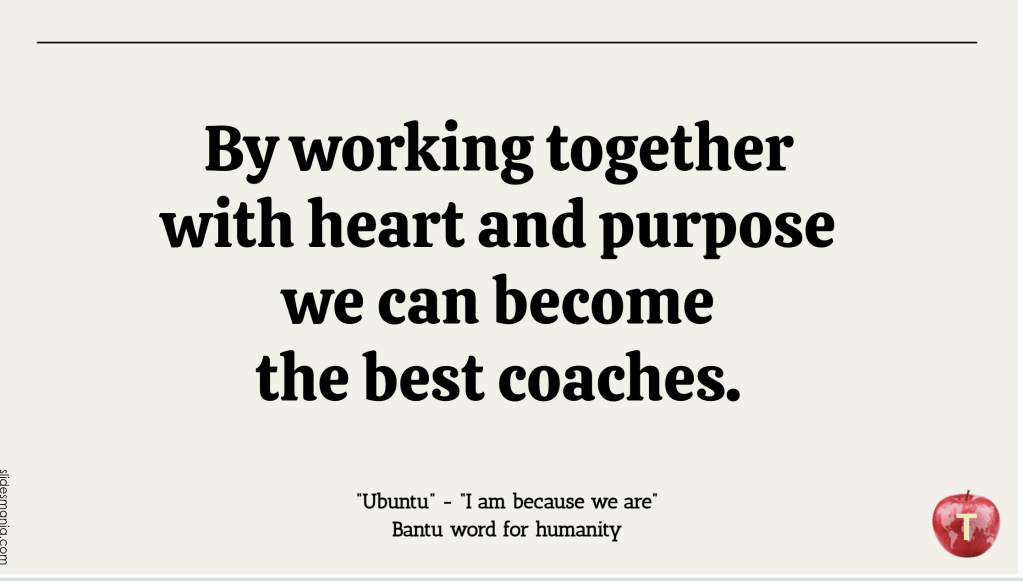
For our PD day, after some relationship building activities and creating our team’s Social Contract (Capturing Kids’ Hearts) we moved into the focused “Coaching Corner” PD portion of the day. Our grounding (transitional) phrase was “By working together with heart and purpose we can become the best coaches,” and we connected everything to that statement.
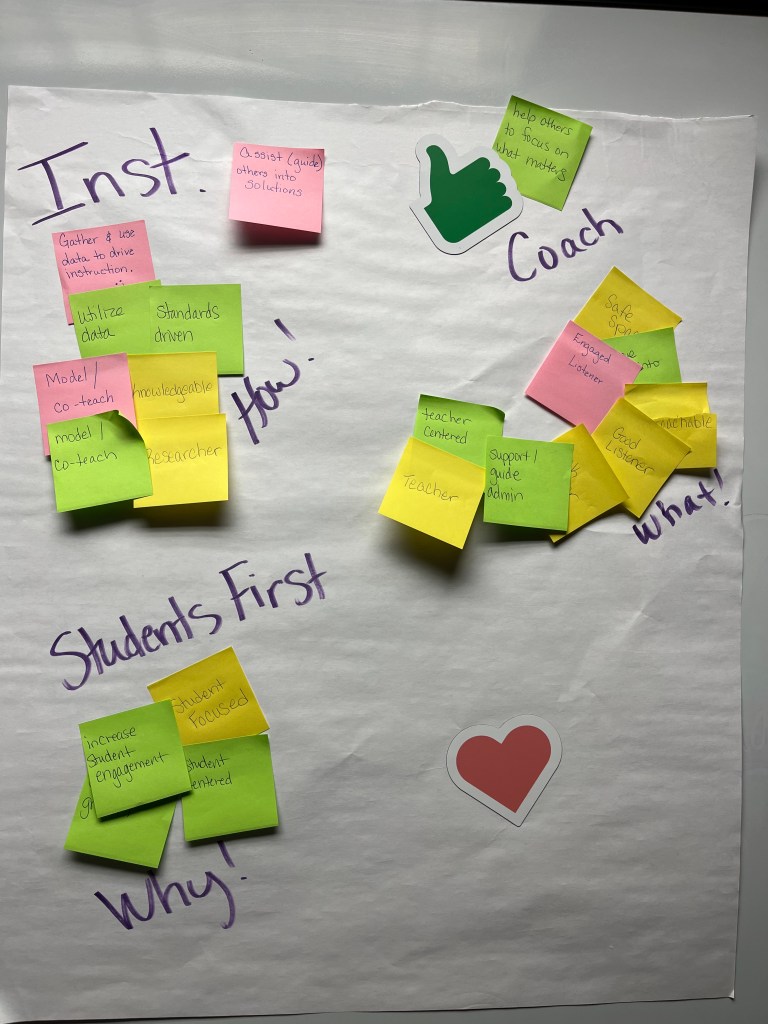
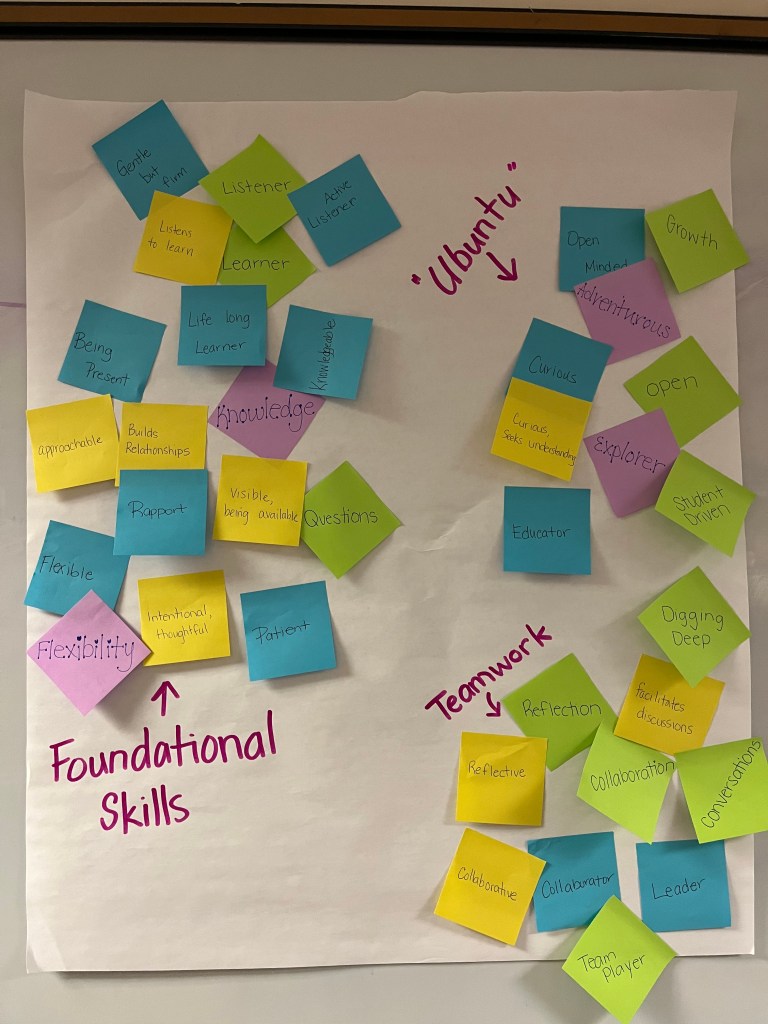
The coaches used Affinity Mapping to help gather and organize our collective knowledge about coaching using the prompts: What is an academic coach (Instructional Coach/ Academic Interventionist)? What makes a successful academic coach? They independently brainstormed, then collectively reviewed the ideas to gain insights into the themes/areas of coaching. I appreciate the wealth of experience our coaches brought to this activity and their understanding of the many pieces involved in being a successful coach.
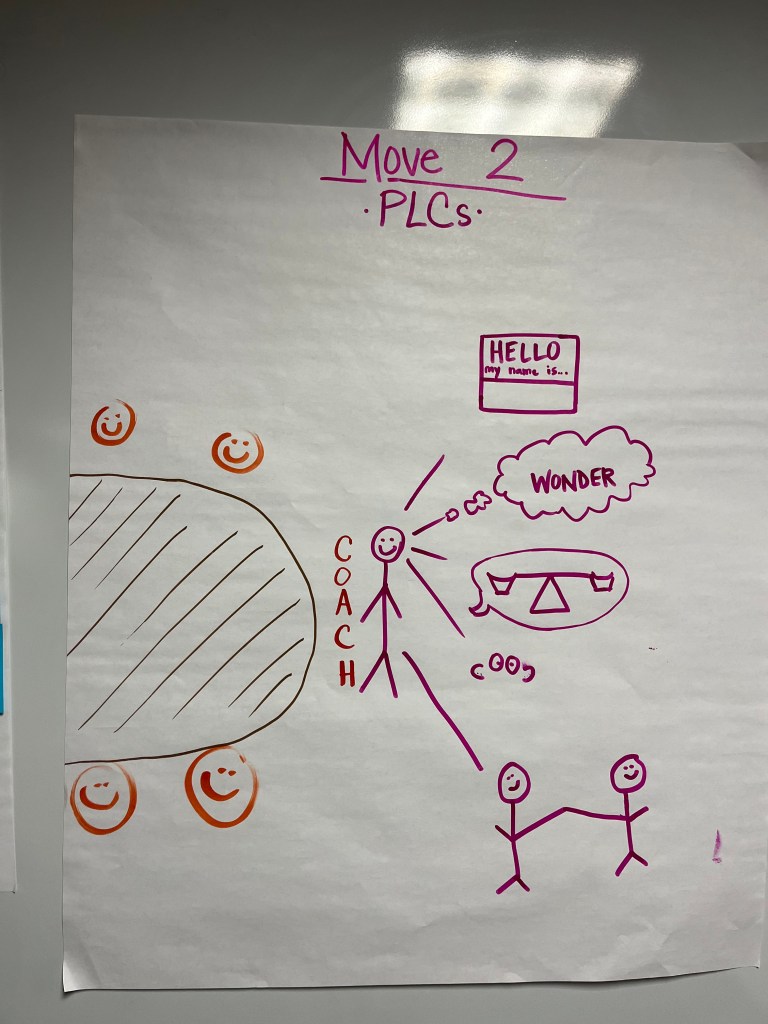
We then moved into a modified jigsaw using the first section of Moves for Launching a New Year of Student-Centered Coaching by Diane R. Sweeney, Leanna S. Harris, and Julie Steele. We used this book two years ago, but felt like it was important to revisit because of its laser focus on the start of school and because we have many new members on our team. Each group created a visual that we would be able to display in our teacher training center and revisit as needed.
The next part of our “Coaching Corner” came from a session I attended at ISTE in June. While at ISTE I attended a variety of sessions related to instructional coaching hoping to gather ideas for this new team. One was called “Pitch Perfect Coaching: Mastering the Elevator Speech to Rock Their Role” presented by fellow ISTE Certified Educator Jennifer Graham (@jlg523) from North Carolina. I contacted Jennifer after ISTE to ask if she’d be willing to let us adapt her presentation. I love how educators are willing to share what they do to help others! Using that modified presentation, our team walked through the steps of creating “concise and engaging” speeches they could use with teachers, administrators and others as they head back to school.
The rest of our day included updates from district content coordinators and specialists (math, ELA, science and social studies), grade level collaboration, developing coaching schedules and resources as well as covering our own “Nuts & Bolts” of back to school items.
The whole PD day was filled with positive sharing and excitement about what our new team will be able to do to support teachers in our schools.
I can’t wait to see how our #D5Coach team exemplifies “Growing Together” this year!
It’s wonderful to have a daughter who goes to school where you teach. It’s even better to have a daughter who cares about what you do during the day and asks you about it.
Last Friday while eating dinner, my daughter asked what I’d done that day (as she does most days). I told her how I’d helped five biology classes use our Class VR virtual reality goggles to look inside a eukaryotic cell and helped world history students build “Choose Your Own Adventure” stories to demonstrate their knowledge of trade routes. We talked about how interesting it is to work with students at all levels and with a variety of teachers.
Her next question has stuck with me all weekend: “Mom, a few years ago did you ever think you’d be showing students virtual reality tours of the cell?”
The truthful answer is no.
When working with seniors in English classes, public speaking classes, and ACT/SAT prep, I never could have imagined all of the different types of teaching and learning I’d be involved in just a few years later.
What my role has allowed me to do with technology is awesome! From virtual reality and digital breakout boxes to student portfolios and live video calls, my role as the school’s Digital Integration Specialist allows me to explore more than I ever thought possible.
But it’s not just the technology tools that encourage me to grow and change. In my role I observe phenomenal teachers throughout our building and learn from them every day. I have endless opportunities to collaborate with teachers in all departments and in many different subjects. Through co-planning and co-teaching lessons, I’m able to explore statistics, economics, German, music, chemistry, art, creative writing, engineering, and so much more.
The variety of students I get to work with is also amazing. I work with students in our highest AP courses and in our honors STEM magnet program as well as with students in our life skills and special services classes. I have always believed that everyone has something to offer the world and working with our students only confirms this belief.
So, did I ever imagine I’d be showing VR videos of human cells and talking to students about Golgi apparatus and organelles? No, no I didn’t. But I’m so glad I have a job that not only allows but encourages me to try new things.
I am grateful for the daily opportunities I have not only to teach, but to be a learner as well.





 Reflections of an Instructional Coach